人瑞潛力股!身體若「有5個表現」:你會比一般人更長壽
🥈0.8~1.1米/秒:中等
🥉<0.8 米/秒:較慢

圖片來源:網路
✅ 方法二(日常):
自然行走 1 分鐘,計步數,如果:
60~70 步:速度良好
<50 步:速度偏慢
如果步速優秀,繼續保持;如果偏慢,可從短距離快走開始,每周 3 次,逐步提升~
走得快一點,穩一點,健康就能走得更遠一點。快和家人一起競速走吧。
圖片來源:網路
Advertisements
長壽信號四:站得穩,身體自帶平衡保險
單腿站立考驗的是肌肉力量、神經協調、關節穩定和大腦控制能力。
這套系統越強,跌倒風險越低,生活自主性越高,健康壽命自然更長。
2022 年《英國運動醫學雜誌》發表了一項持續 7 年、對 1700 余名中老年的追蹤研究,結果令人驚訝:
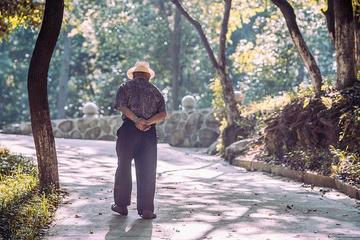
無法單腿站立 10 秒的人,未來 7 年死亡率高達 17.5%!
能輕鬆完成的人,死亡率僅為 4.5%。
調整年齡等因素后,無法完成者的死亡風險增加了 84%
另一項研究更直接:50 歲以上人群若站不到 10 秒,死亡風險可能翻倍。
居家自測方法很簡單👇:
雙手自然下垂或叉腰,單腿站立,另一腿屈膝抬起,計時保持姿勢。如果——
Advertisements
🏆 >10 秒:優秀!身體穩定系統運行良好
👍 5~10 秒:合格,但有提升空間
💪 <5 秒:建議重點訓練,尤其年長者
日常生活中,可以這樣無痛鍛煉:
1. 刷牙平衡挑戰:早晚刷牙時,輪流單腿站立,從每側 10 秒開始,逐步延長
2. 沙發腳踝充電:坐著看電視時,雙腳平放地面,反覆抬起腳後跟,感受小腿發力。每組 15 次,每天 3 組。

圖片來源:網路
Advertisements
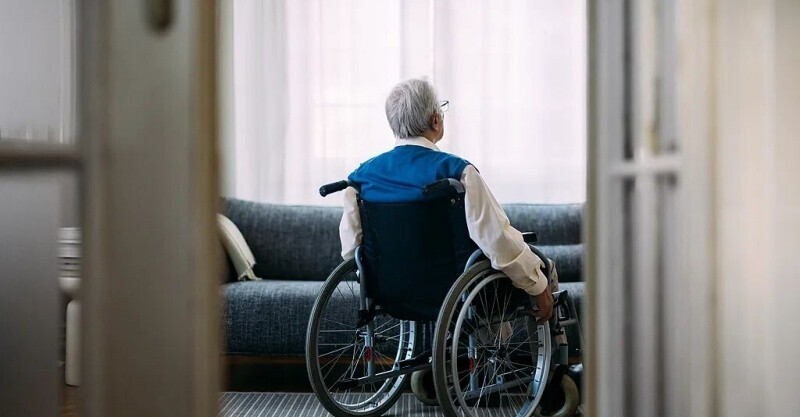
長壽信號五:生活能自理,是最實在的福氣
別以為能自己吃飯穿衣是小事,科學上稱為日常生活活動能力,它比你想象得更重要。
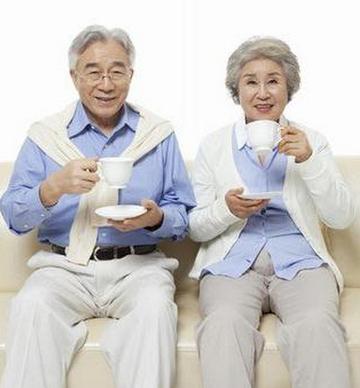
日本大型研究(針對近 9000 名高齡居民)發現,與生活完全自理的人相比:
⚠️完全依賴他人者,死亡風險高出 6.6 倍
⚠️重度依賴者,風險高出 2.9 倍
⚠️中度依賴者,風險高出 2.5 倍
英國長期追蹤(6000 餘人隨訪 10 年)證實:
Advertisements
💀出現自理困難的人群,死亡風險增加 30%
💀身體機能的衰退徵兆,可能在死亡前 10 年就開始顯現
相信下面這些事情絕大部分人都能做到,你也可以轉發給爸媽,看看他們能做到多少——
✅ 起床關:不藉助外力,自己坐起下床
✅ 穿衣關:獨立穿好衣褲,處理好扣子拉鏈
✅ 洗漱關:走到洗漱台,完成刷牙洗臉
✅ 如廁關:獨立使用馬桶並清潔
✅ 進食關:準備簡單早餐並吃完
✅ 移動關:在家中自由走動,無需扶牆
如果某些關卡感到吃力,別擔心,兩個方法維護升級(如果發現自己或家人在這些基礎活動上持續出現困難,建議及時就醫評估,早期干預效果更好。)
1️⃣ 家務即訓練:
把擦桌子、掃地、整理床鋪當成維護手臂、腰腿力量的功能訓練。
2️⃣ 建立生活小儀式:
Advertisements
每天安排幾件固定事項:澆花、散步、讀報
看完了這5大長壽信號,快來對照達標了幾個?
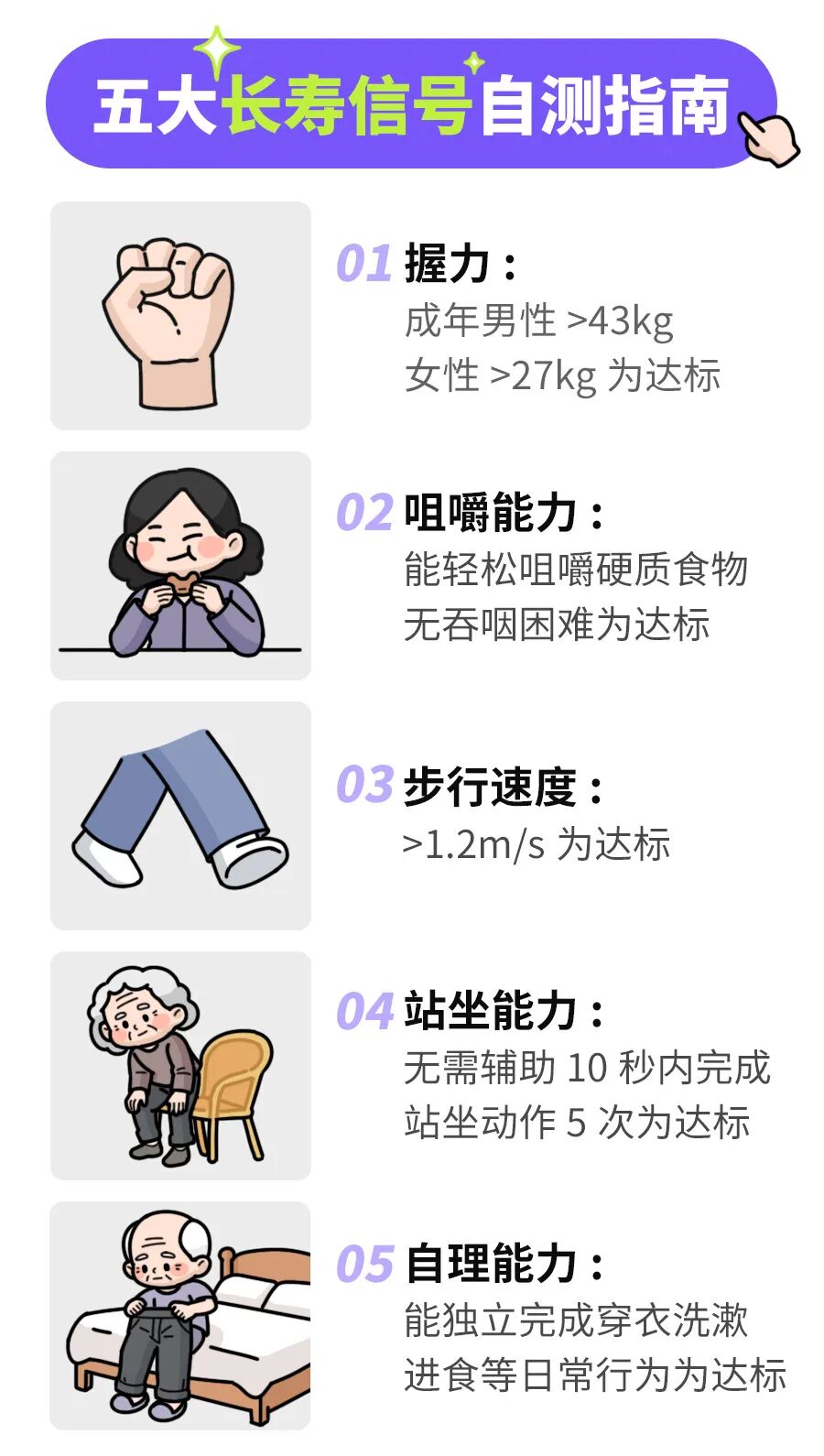
✅ 牙口好,吃什麼都香
✅ 手勁足,提東西不費力
✅ 走路快,步伐穩
✅ 單腿能站穩
✅ 生活小事全能自己搞定
我們特別整理了這份 【五大長壽信號自測指南】 ,將這篇文章收藏轉發給你關心的家人朋友,和他們一起做個簡單的長壽體質自測吧~
Advertisements
大家一起定期進行力量訓練、保持平衡練習、注重口腔健康、積極管理慢性病,許願:🎋活到 100 歲!
圖片來源:網路
本文合作專家:馮茹

運動生物力學博士
Advertisements
南京體育學院教師
本文審核專家:衛嘉慧

美國註冊物理治療師
杜克大學康復醫學博士
參考文獻
[1]Araujo, C. G., De Souza E Silva, C. G., Laukkanen, J. A., Fiatarone Singh, M., Kunutsor, S. K., Myers, J., Franca, J. F., & Castro, C. L. (2022). Successful 10-second one-legged stance performance predicts survival in middle-aged and older individuals. British Journal of Sports Medicine, 56(17), 975~980. https://doi.org/10.1136/bjsports-2021-105360
[2]Goldney, J., Dempsey, P. C., Henson, J., Rowlands, A., Bhattacharjee, A., Chudasama, Y. V., Razieh, C., Laukkanen, J. A., Davies, M. J., Khunti, K., Yates, T., & Zaccardi, F. (2023). Self-reported walking pace and 10-year cause-specific mortality: A UK biobank investigation. Progress in Cardiovascular Diseases, 81, 17~23. https://doi.org/10.1016/j.pcad.2023.09.003
[3]Karunananthan, S., Moodie, E. E. M., Bergman, H., Payette, H., Wolfson, D., Diehr, P. H., & Wolfson, C. (2019). The association between physical function and proximity to death in older adults: A multilevel analysis of 4,150 decedents from the Cardiovascular Health Study. Annals of Epidemiology, 35, 59-65.e5. https://doi.org/10.1016/j.annepidem.2019.04.005
[4]Landré, B., Fayosse, A., Ben Hassen, C., Machado-Fragua, M. D., Dumurgier, J., Kivimaki, M., Sabia, S., & Singh-Manoux, A. (2021). Terminal decline in objective and self-reported measures of motor function before death: 10 year follow-up of Whitehall II cohort study. BMJ, n1743. https://doi.org/10.1136/bmj.n1743
[5]Leong, D. P., Teo, K. K., Rangarajan, S., Lopez-Jaramillo, P., Avezum, A., Orlandini, A., Seron, P., Ahmed, S. H., Rosengren, A., Kelishadi, R., Rahman, O., Swaminathan, S., Iqbal, R., Gupta, R., Lear, S. A., Oguz, A., Yusoff, K., Zatonska, K., Chifamba, J., … Yusuf, S. (2015). Prognostic value of grip strength: Findings from the Prospective Urban Rural Epidemiology (PURE) study. The Lancet, 386(9990), 266~273. https://doi.org/10.1016/S0140-6736(14)62000-6
[6]Nakazawa, A., Nakamura, K., Kitamura, K., & Yoshizawa, Y. (2012). Association Between Activities of Daily Living and Mortality Among Institutionalized Elderly Adults in Japan. Journal of Epidemiology, 22(6), 501~507. https://doi.org/10.2188/jea.JE20110153
Petermann-Rocha, F., Parra-Soto, S., Cid, V., Venegas, P., Huidobro, A., Ferreccio, C., & Celis-Morales, C. (2023). The association between walking pace and grip strength and all-cause mortality: A prospective analysis from the MAUCO cohort. Maturitas, 168, 37~43. https://doi.org/10.1016/j.maturitas.2022.11.004
[7]Stanaway, F. F., Gnjidic, D., Blyth, F. M., Couteur, D. G. L., Naganathan, V., Waite, L., Seibel, M. J., Handelsman, D. J., Sambrook, P. N., & Cumming, R. G. (2011). How fast does the Grim Reaper walk? Receiver operating characteristics curve analysis in healthy men aged 70 and over. BMJ, 343(dec15 1), d7679~d7679. https://doi.org/10.1136/bmj.d7679
Studenski, S. (2011). Gait Speed and Survival in Older Adults. JAMA, 305(1), 50. https://doi.org/10.1001/jama.2010.1923
[8]Wang, Y., Liu, Y., Hu, J., Guan, H., Wang, Y., Liu, M., He, L., Sun, N., Yang, W., & Ma, Y. (2022). Association of handgrip strength with all-cause mortality: A nationally longitudinal cohort study in China. Journal of Science and Medicine in Sport, 25(11), 878~883. https://doi.org/10.1016/j.jsams.2022.08.005
[9]Wu, Q., Li, G., Zhang, X., Pan, Y., Chen, S., Chen, J., & He, Q. (2025). Systematic review and meta-analysis of the association between usual walking speed and all-cause mortality and risk of major non-communicable diseases. Journal of Sports Sciences, 43(14), 1364~1377. https://doi.org/10.1080/02640414.2025.2496082
策劃製作
策劃:橙月 | 監製:Feidi 王姐
插圖:搞錯餃子 | 封面圖來源:搞錯餃子
來源:微信公眾平台